Rethinking the Digital Product Passport: Why SupplyOn Is Making Material Master Data a Strategic Backbone


Global supply chains are at a turning point. What was long considered an operational discipline is increasingly evolving into a data-driven management task under regulatory pressure.
Sustainability requirements are becoming increasingly stringent, data requirements are growing exponentially, and companies must manage both across complex, international supplier networks. At SupplyOn, we are observing this transformation across all industries. Regulations such as the EU Battery Regulation, Carbon Border Adjustment Mechanisms (CBAM), Packaging and Packaging Waste Regulation (PPWR), EU Deforestation Regulation (EUDR), and in particular the upcoming Digital Product Passport (DPP) are not only changing the requirements—they are changing the logic of data transfer in supply chains.
The Digital Product Passport
The Digital Product Passport (DPP) is a digital dataset that consolidates all essential information about a product throughout its entire lifecycle, from material composition and manufacturing through use to repair, reuse, and recycling. In addition, the DPP serves as a central integration point where requirements and data from other product-related EU regulations (e.g., REACH, Battery Regulation, Ecodesign, EUDR) will also be consolidated and made available in a standardized format in the future. The DPP is being introduced as part of the EU’s “Ecodesign for Sustainable Products Regulation” (ESPR), with the aim of creating transparency, enabling a circular economy, and promoting sustainable product design. The rollout will occur in phases by product group, starting with prioritized categories such as batteries and textiles, and will eventually be expanded to cover nearly all physical products. The EU’s goal is widespread adoption, so that the Digital Product Passport becomes the standard for nearly all physical products in the EU internal market.
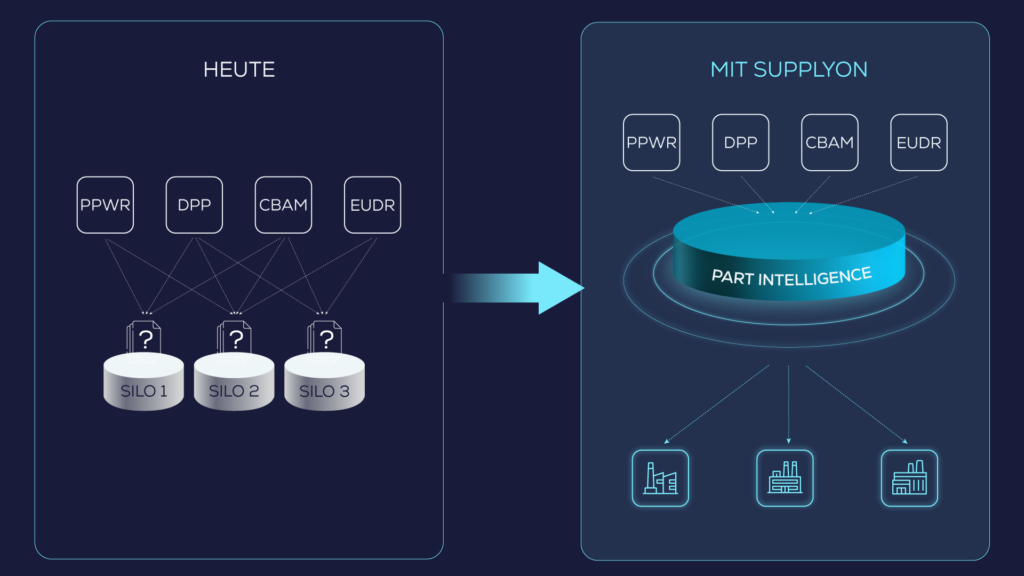
The problem today: The data landscape is fragmented. Different data models and inconsistent requirements across customers—and even departments—lead to suppliers being flooded with countless incoherent data requests.
This, in turn, results in low response rates, poor data quality, isolated data silos, and high operational costs. This is where SupplyOn comes in with its new data hub concept, “Part Intelligence.” The underlying idea is kept simple on purpose: data is captured once, stored centrally, and then used across the entire network. Instead of repetitive, isolated data queries, this creates a shared data backbone for purchased parts.
At its core, the approach is based on a flexible metamodel that integrates material data, parts, plants, and suppliers, creating a unified foundation for various regulatory and operational requirements. SupplyOn continuously monitors legal requirements and consistently translates them into standardized data requirements.
At the same time, automation and AI make the data hub efficient and user-friendly. Validation mechanisms, intelligent workflows, and AI-powered data extraction and prefilling functions ensure that data quality and compliance no longer have to be primarily managed manually.
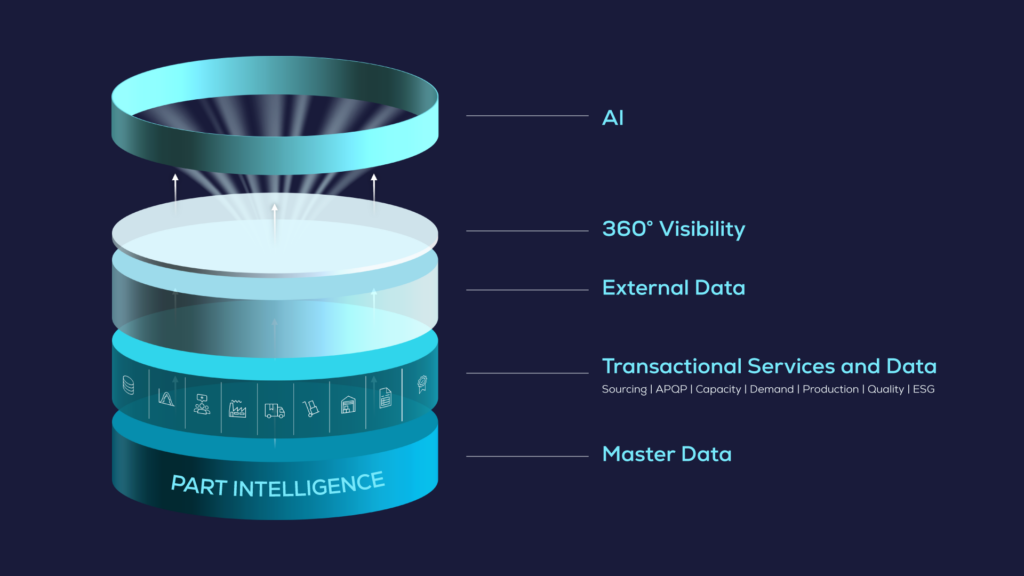
This creates end-to-end transparency for buyers. Data gaps and compliance risks become visible early on and can be mitigated. For suppliers, complexity is significantly reduced: instead of multiple data entries, a centrally maintained dataset is created that can be used across different customers and use cases.
This fundamentally shifts the role of supply chain data: from a regulatory obligation to a strategic lever for efficiency, transparency, and innovation.
Likewise, the focus is shifting: away from the isolated fulfillment of individual regulatory requirements, toward the establishment of a shared, scalable data infrastructure as an industry standard.
The SupplyOn solution “Part Intelligence” is designed as a response to precisely this development: as a shared, trusted database that makes regulatory complexity manageable while paving the way for data- and AI-driven supply chains.