

For large corporations, supplier data has become one of the most critical foundations for resilient, compliant and future-ready supply chains. Whether it is product information, material data, sustainability requirements, regulatory reporting or customer-specific data requests – suppliers are increasingly asked to provide more information, more often, and in more detail.
But the question is not only: Which data is needed?
The more important question is: How do we make it as easy as possible for suppliers to provide the right data, at the right time, at the required level of quality?
At SupplyOn, we believe that successful digitalization does not happen by building solutions in isolation. It happens when technology, business needs and the reality of supplier work come together.
That is where our global supplier community becomes a powerful asset.

From assumptions to real supplier input
In the context of our recent initiative “Part Intelligence”, we looked at how supplier part data could be managed and reused more intelligently across multiple customers.
The idea behind it is simple, but highly relevant: instead of asking suppliers for the same or similar information again and again, a more supplier-centric approach could help manage part data centrally and reuse it across different requests, customers and use cases.
To validate this direction, we did not start with internal assumptions alone. We started with the suppliers’ perspective.
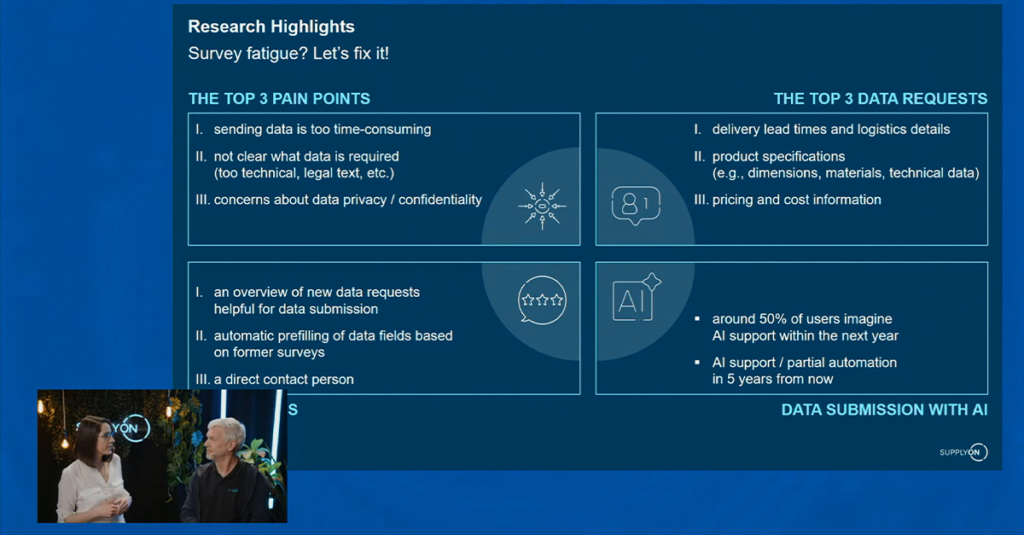
Through our vast Supplier Community, more than 700 suppliers shared their challenges, expectations and pain points. This broad feedback gave us a much clearer understanding of where suppliers struggle today – from repeated data entry and fragmented requests to unclear requirements and manual effort.
These insights were then deepened through targeted interviews and translated into concrete product ideas.
Bringing ideas back to the community
The next step was just as important: bringing these ideas back to the supplier audience.
In a dedicated Supplier Community Event, more than 300 suppliers joined live to review and validate early concepts. The session was not designed as a one-way presentation. It was built as an interactive validation format, giving suppliers the opportunity to react, challenge and actively shape the direction.
The response was strong: around 80% of live participants engaged in the polls.
That level of participation shows something important. Suppliers are not only willing to provide feedback when asked. They are ready to engage when they see that their input can influence what comes next.
Even more encouraging: more than 20 suppliers proactively volunteered to participate in follow-up interviews and pilots.

Why this matters for buying organizations
For buying companies, this approach creates value beyond a single product initiative.
When suppliers are involved early, potential adoption barriers become visible before rollout. Pain points can be identified before they become obstacles. Product ideas can be validated with the people who will actually use them.
This helps reduce friction, improve relevance and increase the likelihood that new solutions are accepted by suppliers – not just technically deployed.
For procurement, supply chain, sustainability and compliance teams, this is especially important. Many initiatives depend on supplier participation. A solution can be strategically important for a buying organization, but if it creates too much effort on the supplier side, adoption becomes difficult.
That is why supplier-centric validation is not just a nice-to-have. It is a practical way to increase impact.
The power of a structured supplier journey
The key success factor was not a single event. It was the full journey.
- First, broad input was gathered from the supplier base.
- Then, insights were deepened through interviews.
- Next, early ideas were brought back into the community for live validation.
- Finally, interested suppliers were identified for further collaboration and pilots.
This creates a structured funnel: from broad community feedback to targeted validation and concrete supplier involvement.
For large buying organizations, this is highly relevant. It means that supplier perspectives can be integrated systematically – not randomly, not too late, and not only after rollout.
A network advantage beyond software
SupplyOn connects buying organizations with a large global supplier network. But the value of this network is not limited to transactions, processes or technical connectivity. It can also be used as a strategic feedback and validation channel.
When we develop new solutions, we can involve the people who are most affected by them. We can test assumptions, validate concepts and understand supplier readiness before scaling.
This is where the network becomes more than infrastructure. It becomes part of the solution.

Building with suppliers, not only for them
This example shows how supplier-centric development can work in practice. It demonstrates that suppliers are willing to engage when the topic is relevant, the format is clear and their input is taken seriously. It also shows that interactive community formats can help bridge the gap between strategic customer requirements and operational supplier reality.
For buying organizations, this is an important signal.
The future of supply chain collaboration will not only depend on better tools. It will depend on solutions that suppliers can understand, trust and use efficiently.
And the best way to build those solutions is to involve suppliers early, validate continuously and use the strength of the network.
At SupplyOn, this is exactly the direction we are taking: building solutions not in isolation, but together with the community they are meant to serve.