Industry News Carbon reduction in the supply chain – three fundamental challenges and solutions Concepts such as decarbonization, net zero or carbon neutrality are now part of the common discourse in customer-supplier relationships. The influence of the supply chain on a product's final ecological footprint (product carbon footprint, PCF for short) is already well known and the efforts to reduce the emissions (Scope 3 upstream) have taken place in many industrial sectors.That's why this article is not about why reducing carbon emissions in the supply chain is the biggest lever to achieve their climate goals. Many studies already describe this and it has been discussed in webinars and at conferences. Rather, the following article will focus on the biggest challenges and highlight possible solutions.Challenge 1 - Data quality and availabilityTo reduce Scope 3 emissions effectively, correct decisions and a good data basis are required. As a company, I create this data by gathering as much real data (primary data) as possible from the supply chain and relying less on standard values or factors (secondary data).What sounds so simple, however, proves to be a significant challenge in practice.How do I retrieve the data?How do I consolidate them?Can my suppliers even deliver the data I need?Are the data I receive from my suppliers correct?Even this seemingly simple question is challenging for many companies - Gartner, in its report "3 Steps to Accelerate Scope 3 Carbon Emissions Reduction in the Value Chain", also identified data quality and availability as one of the most serious problems that companies have to overcome.The PCF data can be queried in different ways. Via e-mail for individual products, via Excel or with a special collaboration tool. Choosing the right way is essential for feedback. It has been shown that e-mail and Excel are often used to launch initiatives, but they quickly reach their limits for all parties involved. Due to the lack of plausibility checks, neither option allows any conclusions to be drawn about data quality and creates further data silos.For this reason, specialized software tools for the exchange of carbon data have become established, such as SupplyOn Product Footprint. In most cases, these tools offer an intuitive user interface, plausibility checks, are integrated into other business processes and are therefore part of an end-to-end collaboration process.This is especially beneficial for small and medium-sized companies (SMEs), as they do not have to introduce additional software, but can work in their familiar environment. Standardized query templates across several customers also ensure greater user acceptance.As a customer, I benefit from a higher return rate and high-quality data. If I want to ask for more details than those provided in the standardized templates, flexible software tools also offer the option of customization, so that I can obtain all the data I need from the suppliers to make my decision.However, care must be taken here not to overload SMEs with overly specific questions, which can either take a very long time to answer or, in case of doubt, cannot be answered.Challenge 2 - EfficiencyWhen I request primary data from my suppliers, it's important to consider what resources they have to deal with the topic of PCF as a whole. As an OEM or Tier 1, I usually have specialists for lifecycle assessment, so-called LCA experts, who deal with this professionally and in most cases have a significantly larger team compared to a Tier 2, Tier 3 or even Tier 4. Hence, it's crucial to recognize that my supplier does not have the same knowledge and resources as I do.Efficiency is a critical success factor in collaboration. Using software solutions for data retrieval is often deemed efficient. In most cases, this is also easier and saves time compared to collaborating via emails or Excel files. However, the journey cannot and should not end there, as the data is initially without context and detached from other business processes.Successful companies integrate the query of PCF values into existing processes along the product life cycle and thus create additional efficiency in collaboration. The purchasing process is a good example of this, as suppliers are already asked to submit their carbon data during the RfQ phase - parallel to the price information and integrated into the sourcing software. The supplier can use a tool to communicate with me as a customer, while I receive all the relevant data at the same time and in a bundled form.SupplyOn Product Footprint's seamless integration into the source-to-contract process provides decisive added value at this point, contributing to more efficient collaboration.However, efficiency is not just a question of the right software. Transparency and communication with suppliers are also crucial in view of the different levels of knowledge about PCF and the limited internal and external resources. The more understanding and knowledge in the supply chain on the subject, the better and faster the data feedback will be.Many companies therefore organize webinars, training sessions or entire supplier days specifically for their suppliers. SupplyOn supports its customers in this process and offers customized supplier community events to cover a wide range in an efficient and resource-saving manner.Challenge 3 - PriorityThe intensity with which companies advance decarbonization efforts is closely linked to the priority placed on sustainability. The importance of dealing with carbon data from the supply chain is influenced, for example, by the delivered industries, legal reporting requirements (keyword CBAM and CSRD) or the company's own corporate goals.Decarbonization competes with many other topics for attention and resources. Cost reduction, digitization, a shortage of specialists, delivery quality, availability - these are all challenges that also need to be overcome. It is therefore important to first define a clear strategy and prioritization within the company.In order to make the importance of PCF values clear to my suppliers, transparency and communication are once again important success factors. Without close cooperation and involvement of suppliers, sustainable carbon reduction along the entire supply chain is not possible. Again, community events and supplier days are among the best practices.In addition, the purchasing side can influence the priority given to suppliers by giving the PCF more weight in the award decision. It is already not uncommon today to take the carbon footprint of a product into account when making purchasing decisions. As the carbon price rises, the importance of the PCF will continue to increase.SummaryIn conclusion, it can be said that purchasing can make a major contribution to the decarbonization of the supply chain despite the major challenges. Selecting the appropriate software, implementing efficient, integrated internal and external processes, and maintaining transparent communication with suppliers are essential components.
Inside Join forces and fight climate change Beginning of July, SupplyOn hosted a Supplier Community Event on the topic of Company Carbon Footprint (CCF) to promote the importance of measuring and reducing carbon footprints within the supply chain. The event was a collaborative initiative of Continental, Bosch, Schaeffler, and Vitesco Technologies, and was run and supported by SupplyOn.The event focused on encouraging suppliers to accurately measure and report their carbon emissions. The tool to do so is provided by SupplyOn through a survey, which allows the information to be obtained very efficiently. The data collected that way is crucial in determining the environmental impact of the supply chain and can help identify areas for improvement. The event aimed to raise awareness about the importance of carbon footprint measurement and provide guidance on calculating and tracking emissions.Throughout the session, experts from the participating companies emphasized the necessity for sustainable business practices. Andrej Antipov from Bosch highlighted the alignment between all companies involved, emphasizing the shared goal of implementing CO2 reporting and reduction measures across the supply chain. As part of Bosch’s climate action activities, the company keeps an eye on emissions in the upstream and downstream stages of its value chain (scope 3). Bosch has the goal to cut such CO2 emissions by 15 percent in absolute terms by 2030 compared with the baseline year 2018.Veronika Leutgäb from Continental discussed their commitment to renewable energy and the importance of suppliers having a roadmap toward using electricity from renewable sources. Continental has joined the global RE100 initiative committing to using green electricity and expects its suppliers to do the same. By increasing the use of renewable energy, CO2 emissions can be significantly reduced throughout the supply chain.The event provided a platform for companies to learn from each other and exchange best practices for measuring and reducing carbon footprints. It was an opportunity for suppliers to understand the expectations of their customers in terms of environmental impact and to work towards aligning their practices with sustainability goals.A major step in driving environmental awareness among business partnersSupplyOn's CCF event marked an important step in promoting environmental consciousness and sustainability within the supply chain. By encouraging suppliers to accurately measure and report their carbon emissions, companies can work together toward creating a greener and cleaner supply chain for a sustainable future.Continental further emphasized its commitment to sustainability and indicated that they are working on enhancing its supplier evaluation process to give greater weightage to sustainability aspects, including carbon neutrality and responsible value chains.Markus Oberender also emphasized that Vitesco Technologies is interested to learn about the general strategy and roadmap of suppliers, e.g., when will they start using only renewable energy and when do they plan on becoming carbon neutral.The Schaeffler Group set itself the goal of achieving climate-neutral operations and reducing CO2 emissions in both in-house production and the supply chain by 2040 – for example, by using renewable energies. Sophia Schmid, from Schaeffler, expressed the importance of the CCF survey in gaining transparency from their suppliers. The survey results will be considered in future supply chain evaluations, underlining their commitment to sustainable sourcing decisions. Vitesco Technologies supported that expression by emphasizing the seriousness of the topic. For them, this will be one of the major issues for the next years. Therefore, the sooner the suppliers start the better.Overall, the event was a huge success, showcasing not only the collaboration of industry leaders in promoting sustainable business practices but also the commitment of their suppliers to support this joint effort. The collaborative endeavor of SupplyOn, Continental, Bosch, Schaeffler, and Vitesco Technologies highlights the importance of measuring and reducing carbon footprints in creating a more environmentally conscious supply chain.
Inside Joining SupplyOn: Tamara’s path from working student to full-time employee New talents will find attractive opportunities at SupplyOn. In particular, students who want to gain practical experience during their studies have great prospects with us. I talked to Tamara, who has just made the step from working student to full-time employee at SupplyOn. (more…)
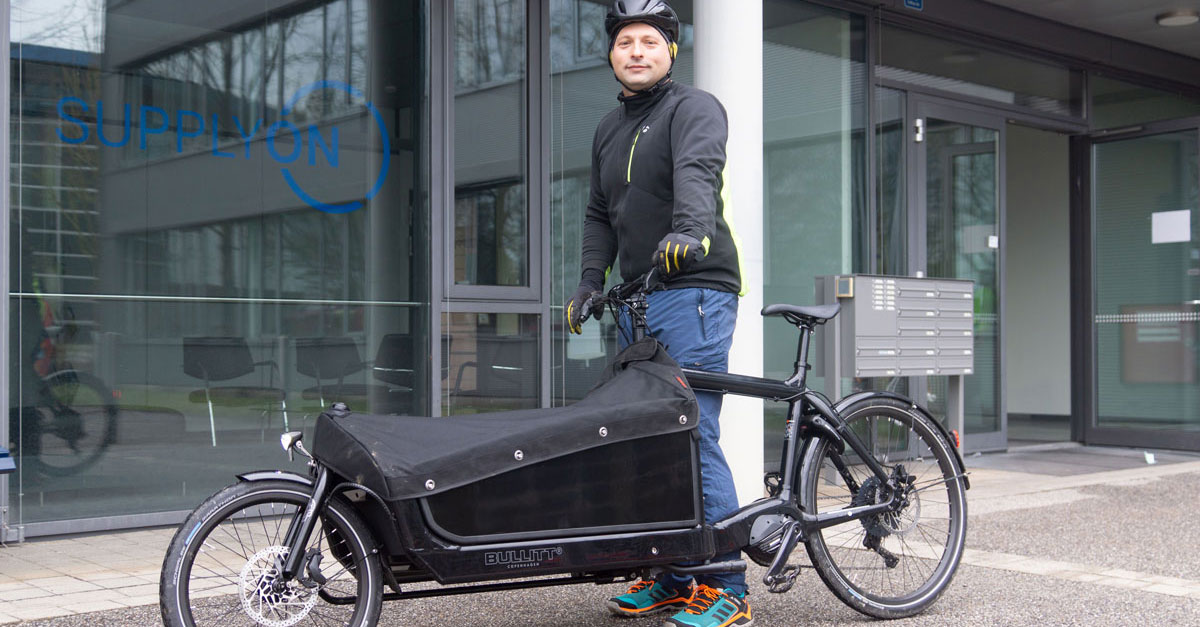
Inside May the (e-)Force be with you: The new Business Bike benefit at SupplyOn STePS eBULLITT EP8 XT Di2 - that's the official name of Dominik's new pride and joy. Or to put it more simply, the best-selling cargo bike on the market with versatile uses such as transporting people, groceries or other loads. Dominik, a passionate cyclist, recently picked up his new business bike at the dealer in Nuremberg. This is one of the new benefits that SupplyOn employees can choose from as part of our so-called cafeteria model. (more…)
Inside User enablement — or how we facilitate usage From the user's perspective, it always involves some effort till she or he can actually successfully use a (new) software or app. This learning process that users go through is also called "user onboarding". It ranges from: "I'll just try this out." All the way to: "I know how to achieve my desired result with this product." Ultimately, it is primarily about teaching users how they can best (or most easily) work successfully with a product. (more…)
Inside SupplyOn User Community — how users co-design our products* Everyone knows this situation: Working with the same software, day by day, taking the same steps over and over again in order to complete our daily tasks. Sometimes questioning, why some things cannot be done any easier or why they are not as we would expect them to be. Wouldn’t it be nice to have someone to discuss these ideas and challenges? And maybe even get to see these ideas being transferred into reality?Within SupplyOn we can make this dream come true: We offer all our users the opportunity to incorporate their ideas and suggestions into product development. (more…)
Inside What does it take to become a manager in the IT industry, Isabella? In the series "How does your working day look like?", employees from a broad range of fields are giving you an insight into their work routine. After speaking with Product Owner Dominik, Isabella, who is team leader in SupplyOn's Consulting division, now takes the floor. (more…)
Inside What does a Product Owner actually do at SupplyOn? Dominik Halamoda describes his working day and tasks Find out how Product Owner Dominik Halamoda masters his tasks at SupplyOn in Munich. Discover the challenges, highlights and how SAFe promotes careers. (more…)
Inside Why SAFe will make us a future-proof partner for our customers In an increasingly complex world, established organizations reach their functional limits and have to come up with new coping strategies. So does SupplyOn, a trusted and successful company network that connects more than 65,000 businesses worldwide. (more…)
SCM Insights How to enhance collaboration between procurement and quality management Digital transformation or not: Working together is often difficult even when system-supported processes are in place. This occurs not just on a large scale, e.g. in the collaboration between companies and their suppliers. It also happens on a small scale, e.g. between different departments. Here companies face challenges such as media discontinuity, a lack of transparency, and processes that are interdependent. (more…)